Free Printable Multiplication Chart Generator
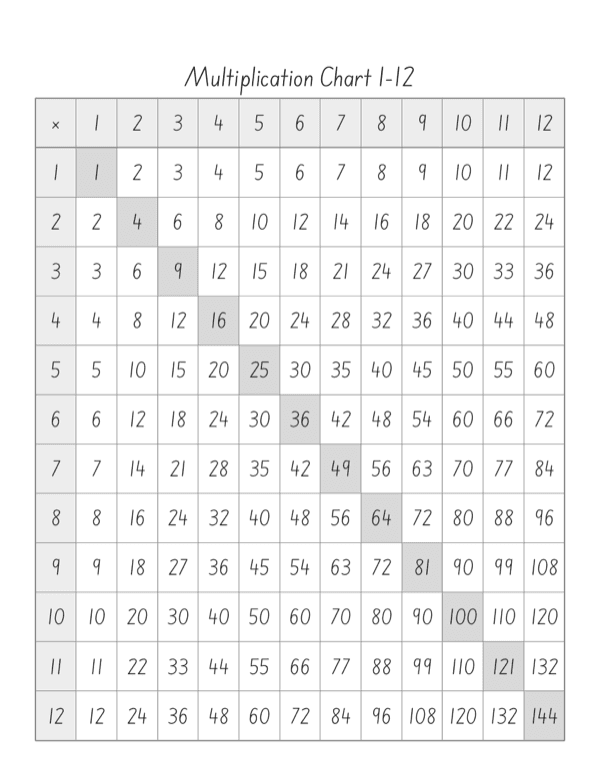
Print exactly the multiplication chart you need — 1-10, 1-12, 1-15 or 1-20, filled in for reference or blank for practice, with an optional highlight on the square facts. Free, instant PDF, no sign-up.
Free download · no sign-up · no watermark
Quick downloads (one click):
How do I print a multiplication chart?
- Pick the range. 1-10 for the classic chart, 1-12 for the classroom standard, or 1-15 and 1-20 for advanced practice.
- Choose filled or blank. A filled chart for reference, or a blank grid the student completes from memory — optionally with the square facts highlighted.
- Generate and print. Click Generate for an instant multiplication chart printable sized for US Letter — or use a one-click preset below the form.
Every multiplication chart printable here is drawn fresh when you click the button, so you are not digging through pages of near-identical downloads for the one grid you actually want. The most-requested versions — the 1-12 chart, the blank 12×12 grid, the classic 1-10 — are one-click presets.
Which multiplication chart should I print?
Match the chart to where the student is, not to how much it can hold — a bigger grid is not better if most of it goes unused:
| Chart | Best for | Why |
|---|---|---|
| 1-10 | Grades 2-3, first chart | The classic 10 × 10 grid — big cells, products to 100, nothing a beginner does not need yet. |
| 1-12 | Grades 3-5, the classroom standard | US classrooms teach times tables through 12 — this is the chart on most classroom walls and homework folders. |
| 1-15 | Extension work | A comfortable stretch past 12 without jumping straight to a dense 20-grid. |
| 1-20 | Advanced & middle school | All facts to 400 on one page — a compact reference for students working with larger numbers. |
Looking for a multiplication chart 1-100?
That name refers to the classic 10 × 10 grid, whose answers run from 1 × 1 = 1 up to 10 × 10 = 100 — not a table with one hundred rows. It is the 1-10 chart preset here: one click, and you have the same printable those searches are after, drawn cleanly on a full US Letter page.
Filled chart or blank grid?
A filled chart is a reference: it hangs on the wall or sits in the homework folder, and the student looks facts up until recall takes over. Print it once at 1-12 and it covers the whole of elementary multiplication.
A blank gridis a workout. The student fills in the products from memory — one row a day, or the whole grid against the clock — then checks the result against a filled chart. Because the grid is generated fresh each time, you can print a clean copy for every session instead of erasing yesterday's answers. Together the two styles make a complete practice loop: look it up, then prove you no longer need to.
Why highlight the square facts?
Tick Highlight square factsand the diagonal — 1, 4, 9, 16, 25 and so on — prints with a light gray background. Those squares are the chart's backbone: they are easy to memorize, they mark where each times table crosses itself, and the chart is mirror-symmetric on either side of them. 3 × 7 and 7 × 3 give the same answer, so a student who knows the squares and one half of the chart knows all of it. The shading is plain gray, not color — it prints identically on any black-and-white printer.
Practice workbooks, coming soon
We're building printable math practice workbooks — structured packets that take a student from reading a chart to knowing every fact cold. The single-chart generator above stays free.
Multiplication chart FAQ
Is this multiplication chart really free?
Yes. Pick a range and style, click Generate, and download your multiplication chart printable (PDF) — no account, no email, no watermark. Single charts are free; full practice workbooks are the paid product we are building.
Which multiplication chart size should I print?
The 1-12 chart is the standard classroom reference — most US schools teach times tables through 12. Print 1-10 for a simpler first chart, and 1-15 or 1-20 when a student is ready to push past the basics.
What is a blank multiplication chart for?
Filling in an empty grid is one of the best ways to practice: the student writes each product from memory, row by row or in random order, then checks against a filled chart. Print a fresh blank grid each time — it also works as a quick timed exercise.
Why highlight the square facts?
The squares (1×1, 2×2 and so on, up to the last fact in your range) run down the chart's diagonal and act as anchor points. The chart is symmetric on either side of that line — 3×7 equals 7×3 — so once the squares are solid, there is only half a chart left to learn.
Where is the multiplication chart 1-100?
A "1-100 chart" is the classic 10 × 10 grid — its answers run from 1 up to 100. That is exactly the 1-10 preset here: one click prints the same chart those searches are looking for.
What paper size does it print on?
US Letter (8.5 × 11 in), in plain black and white with light-gray shading — cheap to print and clearly readable on any home or school printer. On A4, just leave your printer's fit-to-page setting on.
More free generators
Multiplication sorted? Our other free tools cover the rest of the school day:
- Free Spelling Worksheet Generator — Paste any word list and generate printable spelling practice worksheets — five activity styles plus an answer key.
- Free Handwriting Paper Generator (PDF) — Print blank handwriting paper your way — three-line guides or single lines, spacing preset by grade, optional name and date header.
- Name Tracing Worksheets — Free Generator — Type a name and print a custom tracing worksheet with dotted or light-gray letters on ruled handwriting lines.
- Free Alphabet Chart Printable (PDF) — Print alphabet charts your way — uppercase, lowercase or Aa pairs, with optional 1-26 numbers, filled for reference or blank with writing guides.