Free Printable Alphabet Chart Generator
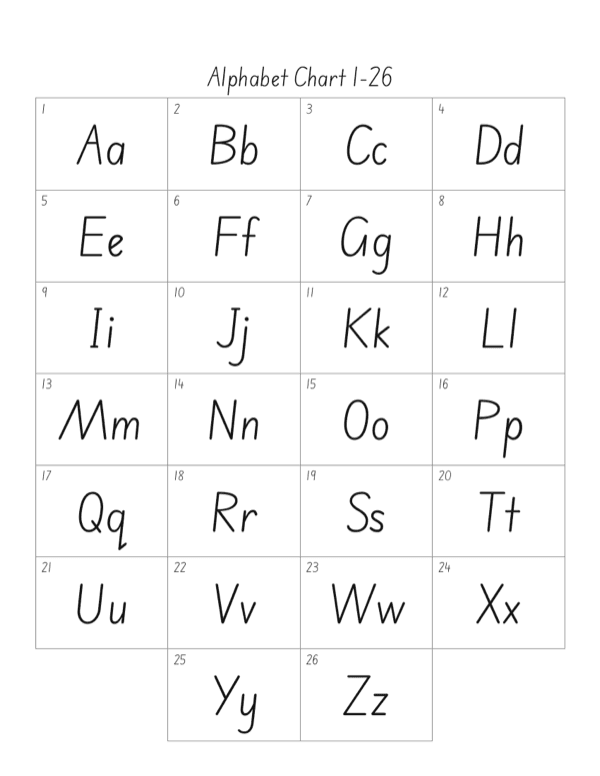
Print exactly the alphabet chart you need — uppercase, lowercase or Aa letter pairs, filled in for reference or blank with handwriting lines, with optional 1-26 numbers. Free, instant PDF, no sign-up.
Free download · no sign-up · no watermark
Quick downloads (one click):
How do I print an alphabet chart?
- Pick the letters. Aa pairs for a classic chart, uppercase only for beginners, or lowercase only for early readers.
- Choose filled or blank. A filled chart for the wall or homework folder, or a blank chart with writing lines the student completes — optionally numbered 1-26.
- Generate and print. Click Generate for an instant alphabet chart printable sized for US Letter — or use a one-click preset below the form.
Every chart is drawn fresh when you click the button, so you are not scrolling through pages of near-identical downloads for the one version you actually want. The most-requested charts — Aa pairs, uppercase only, the blank writing chart — are one-click presets.
Uppercase, lowercase, or Aa pairs?
Match the chart to where the child is, not to what looks most complete — each version has a job:
| Chart | Best for | Why |
|---|---|---|
| Aa pairs | Preschool–K, the classic wall chart | Shows both forms of every letter side by side, so children learn early that A and a are one letter with two outfits. |
| Uppercase | First letters, ages 3-5 | Capitals are built from straight lines and simple curves — most children recognize and write them first. |
| Lowercase | Early readers, K-1 | Nearly everything a child reads is lowercase, so recognizing a b d g at a glance deserves its own chart. |
The 1-26 numbers: every letter in its place
Tick Number the letters and each cell is labeled with its position in the alphabet — A is 1, M is 13, Z is 26. If you came here looking for a letters-to-numbers chart, that is exactly what this prints, laid out cleanly on one page.
The numbers earn their keep in practice, too. Alphabetical order becomes something a child can point to and count. Simple letter-code puzzles — write a word as numbers, decode it back — suddenly run themselves. And on the blank chart, the numbers become prompts: the student writes the letter that belongs at each position. Charts are a habit worth keeping around the house — a printable multiplication chart works the same way for math facts a few grades later.
Filled chart or blank chart?
A filled chartis a reference: it hangs on the wall or sits in the homework folder, and the child glances at it until recognition takes over. Hang it at the child's eye level, not yours — a chart nobody can see teaches nobody.
A blank chartis a workout. Each cell holds ruled handwriting lines — the same three-line guides used on handwriting paper — and the student writes the alphabet in order from memory. It doubles as the simplest letter assessment there is: whatever comes out shaky or missing is next week's practice list. Because the chart is generated fresh each time, you can print a clean copy for every attempt. Together the two styles make a complete loop: look it up, then prove you no longer need to.
From letter names to letter sounds
An alphabet chart printable is most useful in the stretch when a child is linking letter names to letter sounds. Point to a letter and ask for its sound rather than its name; say a word and ask the child to find its first letter on the chart. Five minutes of that, most days, does more than an hour once a week — and because the chart is plain black and white, nothing on the page competes with the letters themselves.
Practice workbooks, coming soon
We're building printable letter-practice workbooks — structured packets that take a child from recognizing letters on a chart to writing them confidently. The single-chart generator above stays free.
Alphabet chart FAQ
Is this alphabet chart really free?
Yes. Pick the letters and style, click Generate, and download your alphabet chart printable (PDF) — no account, no email, no watermark. Single charts are free; full practice workbooks are the paid product we are building.
Should I print uppercase, lowercase, or both?
For a first wall chart, print the Aa pairs — children need to see that A and a are the same letter. Print the uppercase-only chart for a beginner who is still learning capital letters, and the lowercase-only chart once reading starts, since almost everything a child reads is lowercase.
What are the 1-26 numbers for?
Tick the numbers option and each letter is labeled with its position in the alphabet — A is 1, Z is 26. It answers the letter-number lookup directly, and it turns the blank chart into a fill-in exercise: write the letter that belongs at each number.
What is the blank alphabet chart for?
Each empty cell has ruled handwriting lines instead of a letter. The student writes the alphabet in order from memory — a quick assessment that shows exactly which letters are shaky. Print a fresh alphabet chart printable each time instead of erasing.
Why is the chart black and white?
On purpose: it prints identically on any home or school printer, costs almost nothing in ink, and keeps the focus on the letter shapes. The letters use a clear school-print style, the same lettering family used across our generators.
What paper size does it print on?
US Letter (8.5 × 11 in), portrait. On A4, just leave your printer's fit-to-page setting on — the grid scales cleanly.
More free generators
Letters sorted? Our other free tools cover the rest of the school day:
- Free Multiplication Chart Printable (PDF) — Print multiplication charts from 1-10 to 1-20 — filled for reference or blank for practice, with an optional highlight on the square facts.
- Name Tracing Worksheets — Free Generator — Type a name and print a custom tracing worksheet with dotted or light-gray letters on ruled handwriting lines.
- Free Handwriting Paper Generator (PDF) — Print blank handwriting paper your way — three-line guides or single lines, spacing preset by grade, optional name and date header.
- Free Spelling Worksheet Generator — Paste any word list and generate printable spelling practice worksheets — five activity styles plus an answer key.